
Water Damage Restoration Pueblo CO
Sudden plumbing failures and intense seasonal storms require immediate structural mitigation to stop secondary moisture migration. Across our service area, NOAA radar recorded 1,378 hail signatures within about 15 miles between 2021-2025 (2021: 192, 2022: 97, 2023: 466, 2024: 264, 2025: 359). The heaviest recent hail year around this area was 2023, with 466 radar hail signatures inside a 15-mile radius, driving hidden roof compromises and interior water intrusion.
Prefer to talk it through? Ring (719) 555-0141.
Prefer to talk? (719) 555-0141
Reliable Moisture Extraction And Structural Drying
Our crew handles emergency structural drying and complete moisture mitigation across established neighborhoods from Bessemer to Aberdeen.
About 44% of housing units in the community (21,344 of 48,909) were built before 1960, the era of galvanized steel supply lines and cast iron drains.
About 22% of housing units in the region (10,911 of 48,909) were built in the 1970s and 1980s, overlapping the years polybutylene supply piping was commonly installed.
About 77% of housing units across the valley (37,605 of 48,909) were built before 1980, the period when asbestos-containing materials and lead paint were still in use.
A pattern echoed in public discussions is homeowners attempting to extract floodwater independently without commercial drying equipment, only to discover extensive microbial growth thriving behind their baseboards weeks later.
When hidden moisture lingers behind drywall, property owners often need to schedule certified structural mold remediation before rebuilding.
Every site receives a systematic inspection with calibrated moisture meters and infrared thermal imaging to map moisture migration accurately.
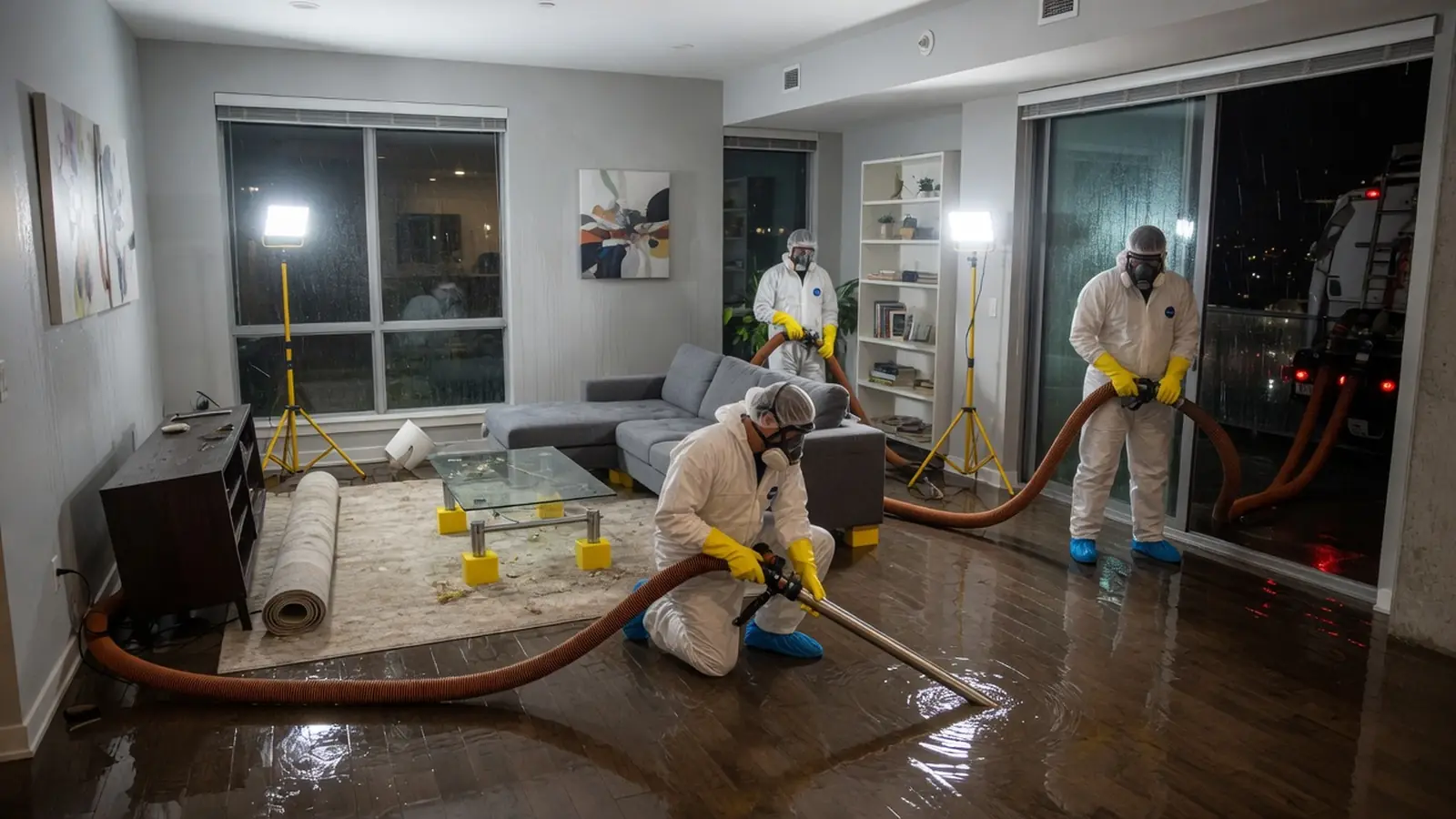
We extract standing wastewater rapidly, sanitize exposed framing, and maintain balanced psychrometric conditions until dry standards are achieved.
How We Solve Your Water Emergency
Our multi-stage restoration protocol stops active saturation and establishes balanced airflow across all structural assemblies. If subgrade runoff breaches your foundation walls, we deploy rapid emergency extraction for persistent basement flooding to preserve floor joists and framing.
- Immediate Thermal Inspection. Our technicians arrive equipped with infrared imaging and moisture meters to map hidden moisture travel behind walls and under floors. As homeowners often describe during severe Front Range cold snaps, attempting to thaw frozen supply lines without professional thermal monitoring frequently causes sudden pipe splits inside wall cavities.
- Water Extraction And Safety Containment. We isolate affected electrical circuits and test moisture thresholds across all structural framing. About 11% of housing units locally (5,350 of 48,909) were built in the 1960s, overlapping the years aluminium branch wiring was installed, demanding extra caution before deploying commercial drying equipment.
- Industrial Dehumidification And Air Movement. High-velocity air movers and low-grain refrigerant dehumidifiers run continuously to draw trapped water vapor out of studs, subflooring, and plaster. We monitor daily psychrometric readings to track evaporation rates until structural materials meet documented equilibrium targets.
- Antimicrobial Treatment And Verification. Technicians apply botanical disinfectants to all exposed framing to neutralize microbial threats and prevent recurring odors. A final comprehensive moisture audit ensures every building component has returned to verified baseline dry standards before reconstruction begins.
Certified Workmanship And Thorough Documentation
We maintain rapid response units equipped with thermal cameras and moisture meters to locate concealed leaks immediately. Our technicians specialize in repairing catastrophic burst pipes after sudden cold waves, ensuring subfloors and wall cavities dry thoroughly. Homeowners often express frustration over wild estimate discrepancies between contractors, which is why we provide transparent thermal moisture mapping that clearly demonstrates whether containment chambers or focused spot drying are genuinely required.
Emergency Water Extraction
High-capacity submersible pumps and truck-mounted vacuum extractors pull standing floodwaters from saturated carpets, basements, and crawlspaces. Removing bulk water rapidly minimizes secondary damage to structural framing.
Structural Drying And Dehumidification
Commercial desiccant and LGR dehumidifiers pull deep moisture from wall cavities, concrete slabs, and subfloors. Continuous monitoring guarantees all building materials reach proper equilibrium.
Sewage And Blackwater Cleanup
Category 3 water intrusions require rigorous biohazard extraction, contaminated porous material removal, and multi-stage hospital-grade sanitization. We ensure living spaces are thoroughly decontaminated.
Our Commitment To Rapid Local Restoration
Every water loss requires immediate intervention to protect structural integrity and indoor environmental safety. We adhere strictly to IICRC S500 standards, deploying calibrated monitoring equipment and documented drying logs on every residential project.
- 12Zip Codes Served
- 7Service Areas
- 3Services Offered
Local property owners share their honest experiences after our technicians resolved urgent moisture emergencies and protected their properties from secondary damage.
“My elderly mother uses a walker, so when a supply line flooded our hallway, I was terrified about cord hazards. The crew kept every drying duct taped securely to the walls and made sure her pathway to the bathroom stayed completely clear and safe throughout the entire drying cycle. Their thoughtfulness during such a stressful situation gave our entire family incredible peace of mind.”
Marcus T.
“Sub-zero temperatures and heavy snow iced up our steep driveway right when our basement took on water. The team hiked equipment up on foot and brought in supplemental heat trailers so the dehumidification schedule never slipped a single hour. They finished the structural dryout right on the original target date despite the brutal outdoor conditions.”
Elena R.
“Our townhome HOA was immediately worried about noisy generator exhaust and parking interference after an upstairs pipe ruptured. This company met with the board president directly, positioned all exhaust dampeners away from shared walls, and kept service vans strictly within our designated stall. They handled all the neighborhood friction with absolute professionalism while drying out our drywall.”
Devon K.
“Six months have passed since our lower level was completely inundated by runoff. Living in the space now, there is zero musty odor, the baseboards remain completely straight, and our follow-up humidity tests are perfectly normal. Them doing the moisture extraction properly from day one saved our finished basement from permanent structural damage.”
Sarah B.
Frequently Asked Questions
How quickly does water extraction need to begin to prevent mold growth?
Water extraction should begin within 24 to 48 hours of initial intrusion before microbial spores germinate inside wet wall assemblies. Prompt action prevents colonies from spreading deeper into studs and drywall.
What factors determine the overall timeline for structural drying?
Structural drying typically requires three to five days depending on material density, ambient humidity, and the volume of trapped water. Denser materials like subfloor plywood and plaster naturally dry more slowly.
How does older home construction affect the water restoration process?
Older residences often require specialized hazardous material containment for plaster, lead paint, or vintage wiring prior to demolition. Controlled extraction prevents contaminating uncontaminated living areas.
Can damaged carpet and hardwood flooring be saved after a leak?
Clean water saturation can frequently be dried in place using specialized injection drying mats if extraction starts immediately. Contaminated floodwaters, however, require carpet pad replacement for sanitation.
Does property insurance typically cover emergency water mitigation?
Standard policies generally cover sudden, accidental pipe ruptures and water damage, whereas ongoing seepage is routinely excluded. Technicians supply itemized drying logs to streamline claims approval.